bReview: Pulp
Saturday 21 February at Spark Arena
Written by Alex Fox
Photography by Jacinda Boyd
Pulp are, put simply, legends. Decades into their existence, they’ve seen themselves compete with the likes of Blur and Oasis at the top of Britpop, and even welcomed controversy surrounding Michael Jackson and the Top of the Pops. But they’re still going, and they’re as determined as ever to show that they’re not going anywhere. The Britpop heavyweights are touring for their newest album, More, released last year. This is their first stop in five months, and they were greeted with a very full Spark Arena.
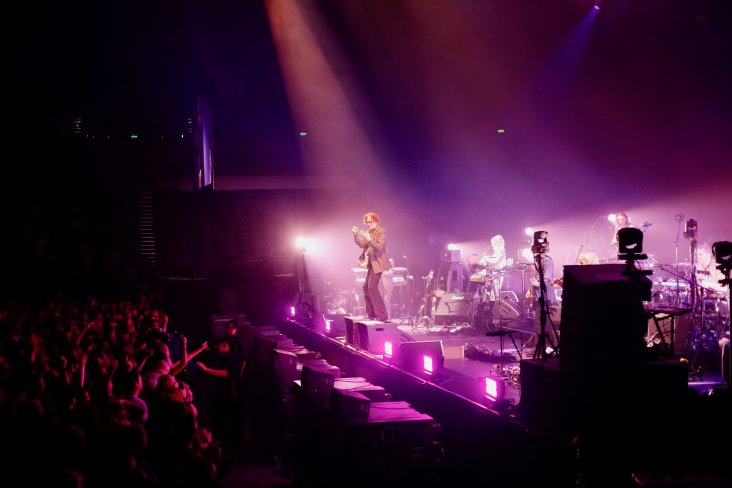
With no opener, the band gets straight into it at 8:30 on the dot. Some static on the screen, and with a deep voice over promising us “more” and demanding we make noise, the 8 members of the band (frontman excluded) take to the stage. The first song, Sorted For E’s & Whizz, sees Jarvis Cocker, frontman extraordinaire and iconic oddball, enter centre stage. He wears, unsurprisingly, a turtleneck and a double breasted jacket. Immediately, his stage presence is clear; even just walking around, during the first song of the night, you can tell he belongs on the stage, with even the most mundane movements a part of his odd charm. And, just for an extra touch, the band has decorated the stage with very large versions of those inflatable guys you see at car dealerships.
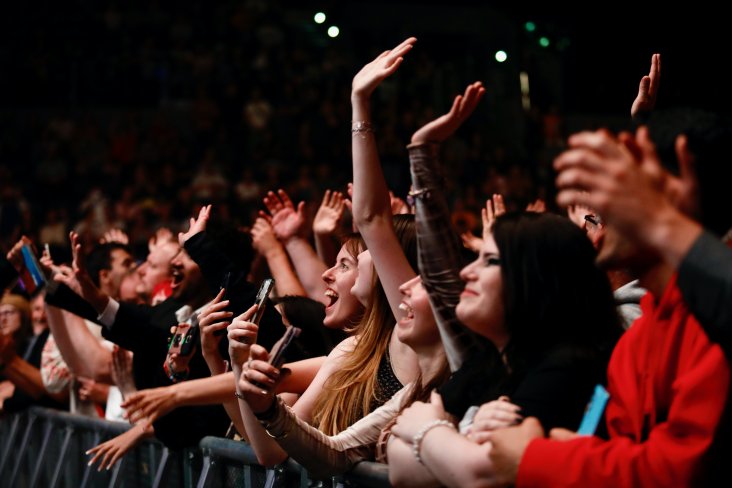
Surprising just about everyone in the room, the second song of the night was one of their certified fan favourites, Disco 2000. But it was clearly the right move, as it took what couldn’t have been longer than six minutes for them to get the crowd cheering, dancing, and singing their hearts out. A strange choice, maybe, but there’s no doubt it pays off.
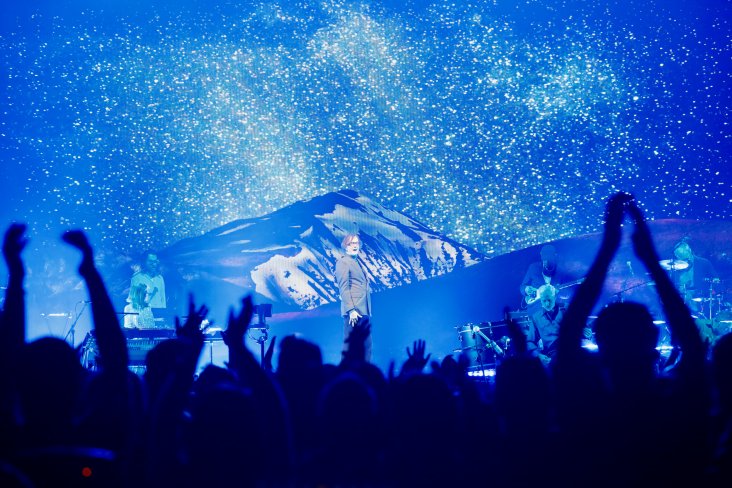
Jarvis takes his first moment to address the crowd with a “Hi… uhm, Kia Ora Aotearoa.” It’s a Saturday night, he says, so we should party. He dedicates the third song, Spike Island, the first single from More, to New Zealand. Because, you know, we are made of two islands. Silhouetted by a large blue circle as a backdrop, Jarvis is in his element. His hands move in a way that, if anyone else was doing it, would look like robotic flailing. But this is Jarvis Cocker, and this is Pulp. He exudes a coolness in his awkwardness that has been honed for decades.
Between songs, Jarvis builds a good rapport with the audience. After Spike Island, he says hi to people he’d met out walking earlier in the day. After the next song, he speaks some more. For a first show in a while, they’d expected it to be quieter. Jarvis introduces us to Limit, a club back in Sheffield where he discovered dance music. This leads us into the 5th song of the night, Slow Jam, which appropriately features a funkier bass line, for what is a deeper, slower, and almost sultry track. Song 6 provides immediate contrast, with the band diving without pause into their most drastic track of the night. Distorted guitars, flashing lights, and at times, two different band members drumming, all while Jarvis sings in his trademark low speaking cadence. The song, F.E.E.L.I.N.G.C.A.L.L.E.D.L.O.V.E, sees the band make a dramatic and enthralling performance out of what feels like a lustful monologue.
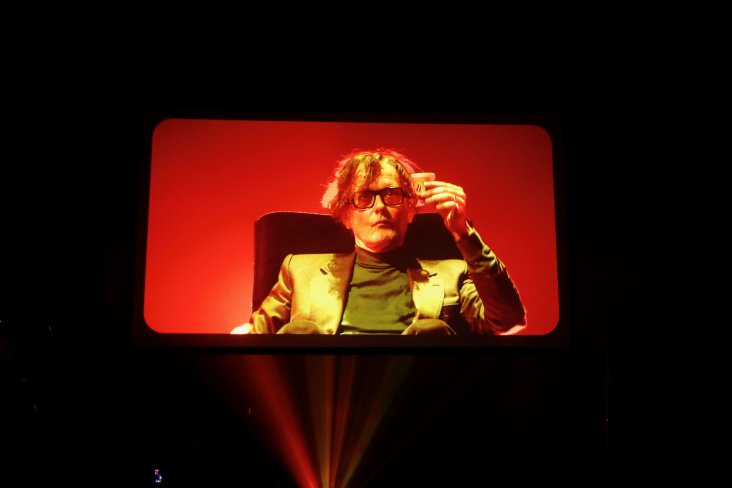
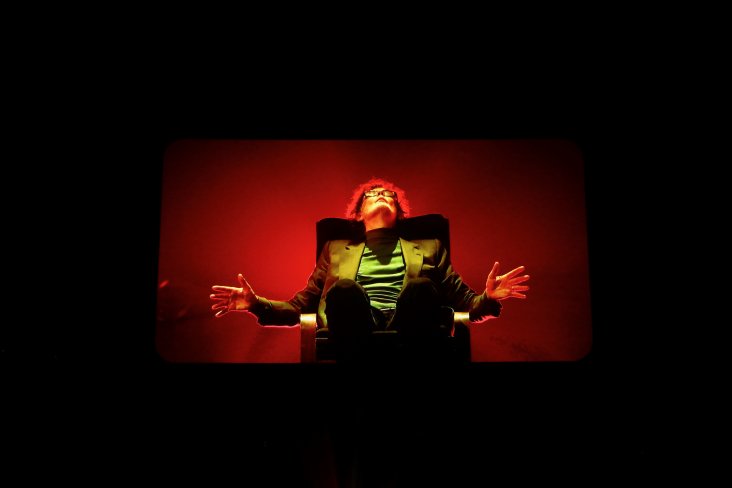
Song 7, My Sex, is introduced by Jarvis as one about sexual confusion, a fact that he immediately has to clear up because it could describe most of the band’s catalogue. Song 8, Underwear, sees Jarvis free his hands up for the first time as a part of his many dance breaks, with the mic hung over his shoulders. Another short break is taken, although the band humorously begin playing while Jarvis is speaking, as he throws out small food items to the audience. No one could have predicted that the biggest spectacle of the night would be Jarvis throwing and catching a grape in his own mouth. Track 10, This Is Hardcore, is another fan favourite, and begins with Jarvis sitting in a chair that has appeared centre stage at some point. The track is severe, with heavy synths, keys, strings, and drums, and a swelling finale, with some of Jarvis’ most emphatic vocals of the night. To close out the first half of the set, the band takes a warmer approach for their 12th song. An acoustic guitar and sun themed visuals give the song a softer and brighter feeling, with Jarvis outstretching his hands as the song ebbs and flows. And with that, what already feels like a full concert comes to an end.
Fifteen minutes (and two cups of water in my case) later, a countdown brings the band back on stage. Just for a moment, they’ve adopted a slightly different setup. The core members of the band have gathered around the centre of the stage. And Jarvis has an acoustic guitar. The first song of the second half is Something Changed, one of my favourites of theirs, and I’d argue one of the best love songs of all time. But that’s neither here nor there. It’s a song that’s even better live, and heralds the second hour wonderfully. The next song sees the energy pick up for a moment, with the return of our inflatable friends, and Jarvis hitting a windmill dance move with his free arm. The energy immediately shifts yet again, with the Sheffield band performing Hymn of the North as their 13th of the night, which is, as its name tells us, a song embracing the North of England. If there’s any fact you should know about the band, it’s that they’re from Yorkshire.
Song 14 is the newest of the night, by virtue of being released two days before. The song, Begging For Change, was released as a part of the roll out for the new War Child album that Pulp is a part of, with this being the most recent single. The song is loud, by Jarvis’ own admission, feeding into yet again a sudden shift of mood. The song also returns to what turned out to be a staple of the show, with a lyrical emphasis on spelling. Following that, Jarvis, of course, has a cup full of Yorkshire Tea bags. The distribution of these bags leads us into Acrylic Afternoons, which sees both an intention to “calm it down”, and Jarvis mounting the speakers and getting up close and personal with the camera setup.
The last time Pulp performed in New Zealand was in 1998, Jarvis tells us, at the North Shore Event Centre. In the spirit of memory, and remembering, the next song is Do You Remember The First Time?. I’m clearly not alone in thinking it's their best, as the crowd erupts with excitement, not taking a breath from singing their hearts out for its whole duration. The song marks, as the end of the concert approaches, what turns out to be an unbroken run of bangers. It is followed by Mis-Shapes, another classic from their Different Class album. The song is dedicated to “unusual people,” before Jarvis turns the lights and cameras onto the audience.
Jarvis introduces the next song as one written towards the end of the last century, that was never released at the time. It was too soppy, he says, and he couldn’t get behind the message. Now, however, he’s a “right f*cking soppy c*nt”. The song, Got To Have Love, found its home on More, and god is that a good thing. Upbeat, warm, and downright anthemic, the song sees the audience chanting the refrain, and doing yet more spelling. Song 17, prefaced with Jarvis checking how much time they had left, is introduced with a bit of film. Featuring clips of Pulp during their 90s heyday, it does a perfect job of introducing the song, Babies, which serves as one of the greatest examples of the odd yet somehow sexy weirdness of Pulp’s catalogue.
As we enter the last two songs of the night, Jarvis addresses the elephant in the room. There is, in fact, “one song we haven’t played”. The band also, apparently, are meant to leave the stage in two minutes. They did not. Common People is undoubtedly Pulp’s flagship song, and for good reason. It embodies the sounds that made Pulp an icon during the Britpop era, and holds a potent and ever-relevant message, that has always been applicable to musical contemporaries who “wanna live like common people.” Naturally, the crowd goes all in on this song, and the band is at their most intense. Jarvis pounds a large drum as he sings of roaches, and struts and sits and dances according to wherever his varying monotonous, snarky, and powerful vocals take him. But just finishing with the song would be too simple, and would be such a waste of the intensity in the room. Just to hold that tension as long as possible, Cocker takes this moment to introduce the entire band. And of course, he introduces himself. He is Jarvis, and he has “one ambition… I wanna live like common people like you.” This, of course, propels the entire arena into a loud, emphatic climax of the entire show; this is Pulp.
Of course, Pulp couldn’t be predictable and end the show there; that wouldn’t be an appropriate finale. Instead, the whole band gathers in the front centre of the stage, in the most acoustic arrangement possible with nine people. The plucking of strings, the strum of guitar, and a beautiful send off with A Sunset, the closing track of More. Fitting, both in terms of order, and the fact that despite over two hours into the concert, it was hard to not want more.
I think back to Cocker’s comment about the last time they performed here in ‘98. Other than instilling within me a North Shore-based pride, this serves to remind us that Pulp have been around for decades, even if their performance gives no indication of losing their touch. In a time where Oasis has reunited, and Damon Albarn shares his recognition between Blur and Gorrilaz, Pulp are here to remind us of Britpop’s soul, thirty years down the line. Cocker, on Spike Island, assures us he “was born, to perform, it’s a calling” and it's hard to disagree. Between his eternal charisma, and the phenomenal work of the band, you can scratch remembering a worse time. I can’t remember a better time.
 95bFM
95bFM